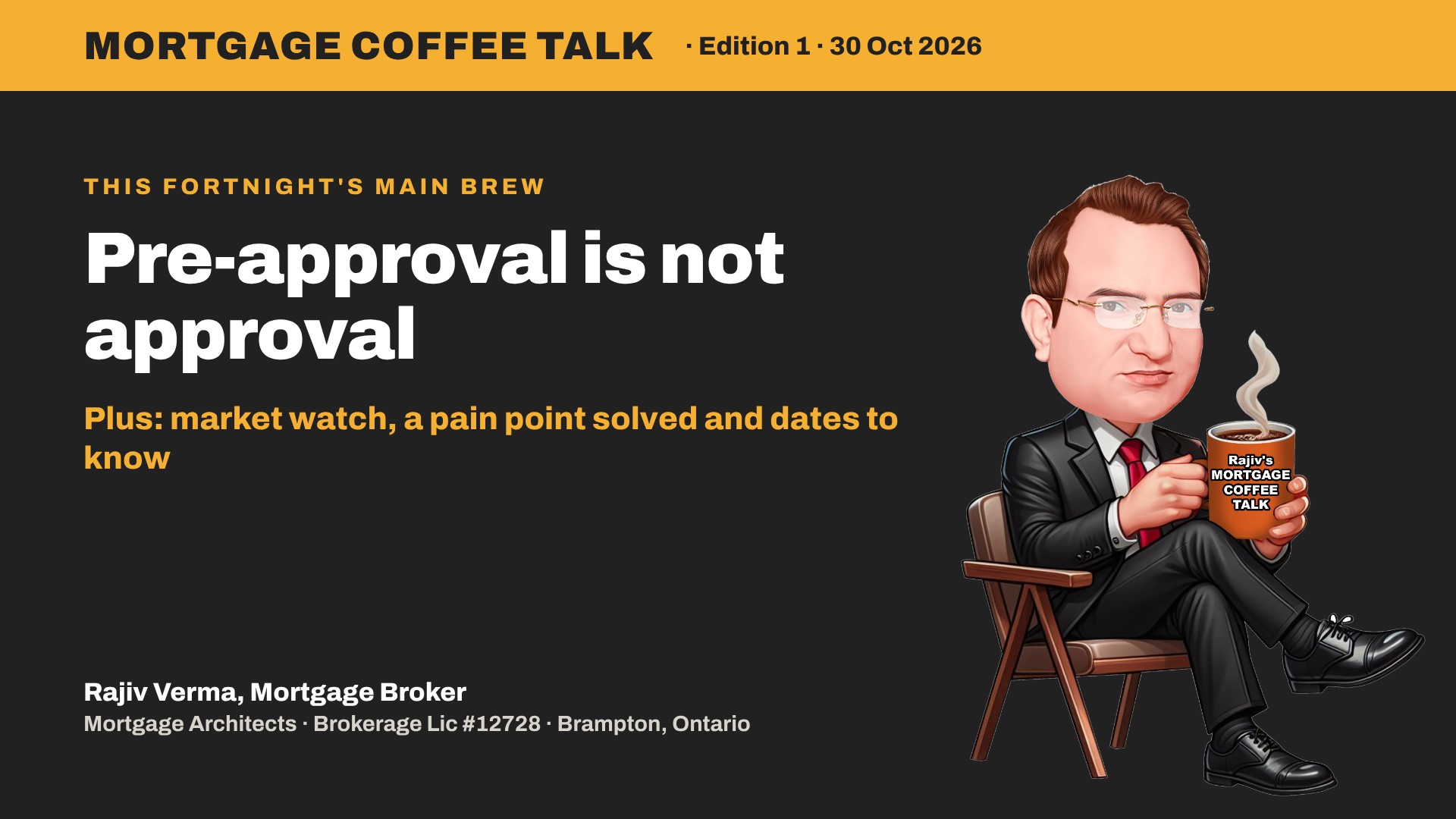
Mortgage Coffee Talk · Edition 1 · 30 October 2026. By Rajiv Verma, Mortgage Broker, Mortgage Architects (Brokerage Lic #12728), Brampton, Ontario.
The first sip
Welcome to the first edition. Every two weeks I will share what I am seeing in real files: the rules that changed, the files that nearly fell apart and what saved them, and one practical tip for the professionals who work alongside me. No rate numbers, no sales pitch. Just the financing know-how I wish every client and referral partner had before the offer. This edition opens with what the Bank of Canada’s rate increase means for you.
Rate news: the Bank of Canada raised its rate. What it means for your mortgage
What happened: on 28 October, the Bank of Canada raised its policy rate by a quarter of a percentage point (0.25%). It is the Bank’s first increase since July 2023. The reason it gave: inflation rose to 3.2% in September, above its target range, mostly because of energy prices, and the Bank wants to stop that from spreading into other prices. It said another increase could be needed, but it will proceed carefully.
The simple version: the Bank of Canada’s rate is the rate banks charge each other to borrow overnight. Each bank sets its prime rate from it, and variable-rate mortgages and lines of credit are priced from prime. When the Bank’s rate goes up, prime usually follows within a day. Fixed mortgage rates work differently: they follow the bond market, not this announcement.
What it costs: a quarter-point increase adds about $21 a month in interest for every $100,000 owed on a variable-rate mortgage or a line of credit.
Who is affected, and how:
- Variable rate with adjustable payments: your payment goes up, usually from your next payment.
- Variable rate with fixed payments: your payment stays the same, but more of it goes to interest and less to the balance. Check how close you are to your lender’s trigger point.
- Home equity and personal lines of credit: interest-only payments go up right away.
- Fixed-rate mortgages: nothing changes until renewal.
- Private and second mortgages: most have a fixed rate for the term, so nothing changes until renewal. Check whether yours is tied to prime.
- Buyers with a pre-approval: a fixed-rate hold protects you while it lasts. On a variable-rate pre-approval, a higher rate can reduce how much you qualify for.
- Renewing in the next six months: your options and the stress test are based on rates on the day you apply, so start comparing early.
- Savers: savings account and GIC rates often edge up.
What I am doing for my clients: reviewing everyone on a variable rate or a line of credit, checking clients with fixed payments against their trigger point, and setting out the options in writing, including converting to a fixed rate.
What I will not do: tell you where rates go next. Instead, three questions. If rates rise again, does your budget still work? If you choose fixed, how likely are you to sell or refinance during the term, and what would that cost? And is the payment comfortable today, without counting on a future cut?
For the professionals: Realtors, re-check any buyer with a variable-rate pre-approval before the next offer. Accountants and planners, flag clients carrying large line-of-credit balances.
Next Bank of Canada decision: Wednesday 9 December, 9:45 am.
Market watch
GTA in September (TRREB): 5,040 sales, down 9% from a year ago. New listings fell faster, down 14.4%. The average price was $1,006,409, down 5.1%, and the benchmark price was down 4.7%.
Municipal elections, 26 October: the councils elected will set local housing, development and land transfer tax policy for the next four years.
What it means: buyers still have choice and time, so there is room for a proper financing condition. Owners renewing should compare options early rather than sign the first renewal letter.
The main brew: pre-approval is not approval
A pre-approval tells a buyer roughly what a lender is likely to lend, based on the documents it has seen so far. It is not a promise to fund the purchase. The final approval comes after an offer, when the lender reviews the property and anything that has changed in the buyer’s file.
When a financing condition fails, the cause is usually inside the buyer’s own file. The four I see most often:
1. A new job. A buyer changes employers after the pre-approval and is now on probation. Many lenders want probation finished.
2. New debt. A car lease, furniture financing or a new line of credit taken out while house hunting. Every new payment reduces what the buyer qualifies for.
3. Money that cannot be traced. Cash deposits, transfers between family accounts, or funds from abroad that arrive late. Lenders must see where every dollar came from.
4. Income the lender cannot use yet. Self-employed or commission income that is not on a tax return.
What helps:
- Keep the file still between pre-approval and closing: no new debt, no job change, no large unexplained deposits.
- Call the broker before any change, not after.
- Keep a financing condition in the offer unless there is a clear reason not to, and give the lender enough time to review the full file.
Rule watch: the foreign buyer ban
What is happening: the federal ban on most non-Canadians buying residential property is currently set to end on 1 January 2027.
Who it affects: work-permit holders and international buyers, and the immigration consultants and lawyers who advise them.
What to remember: even if the federal ban ends, Ontario’s 25% Non-Resident Speculation Tax still applies to buyers who are not citizens or permanent residents, with limited exemptions.
What to watch: a federal decision on whether the ban is extended.
Pain point of the fortnight: “The lender paused my approval ten days before closing”
A composite of files I see often, with details changed.
The pain: a buyer’s parents gave $60,000 toward the down payment. It went into her account as cash over three weeks. Ten days before closing, the lender paused the approval because it could not confirm where the money came from.
Why it happens: lenders must trace every dollar of a down payment. Cash deposits and transfers between family accounts break the trail.
The solution: the parents’ bank statements showing the withdrawals, a signed gift letter, and a short letter explaining each deposit. The lender accepted it, and the deal closed on time.
Prevent it next time: family gifts should move bank to bank, with a gift letter, before the house hunt starts. Keep 90 days of statements for every account the down payment passes through.
For the professionals: lawyers
The pain: a private or second mortgage closing slips at the last minute because a condition surfaces late: independent legal advice for a guarantor or a spouse on title, or debts that must be paid directly from the advance.
The solution: ask the broker for the lender’s full list of conditions on day one. Book independent legal advice as soon as a guarantor or spouse is involved, and request payout statements for every debt being cleared. The closing date holds, and the client is not paying extra interest days.
Myth or fact
“You need 20% down to buy a home in Ontario.”
Myth. With mortgage insurance, the minimum is 5% on the first $500,000 of the price and 10% on the portion above it, for homes up to $1.5 million. A 20% down payment is required above $1.5 million, and it is what avoids the insurance premium.
You asked
“My client is self-employed. How many years of tax returns will a lender want?”
Most lenders want two years of personal tax returns and Notices of Assessment, and they usually average the two years. Some will consider less when the person has a long history in the same line of work. Incorporated clients should also have two years of financial statements ready. I wrote a full guide on how lenders read self-employed files (linked below).
Have a question? Ask it in the comments, and I may answer it in a future edition.
Dates to know
- 31 December 2026: last day for 2026 FHSA contributions to count toward the 2026 tax year.
- 1 January 2027: the federal foreign buyer ban is currently set to end.
- 1 March 2027: RRSP contribution deadline for the 2026 tax year. If an RRSP will fund a Home Buyers’ Plan withdrawal, remember the 90-day rule.
- Mortgage renewing before April 2027? Start comparing now: four to six months ahead is the right time.
This fortnight’s guides
- Self-employed and declined for a mortgage in Ontario
- High income but declined for a mortgage
- Private mortgages in Ontario: when they make sense, what they cost and how to exit
- New to Canada and buying a home in Ontario
- Mortgage renewal in Ontario: when to switch lenders
- Debt consolidation refinance: when it helps and when it hurts
From a client
“An extraordinary service that is consistent for the past 11 years that we are experiencing. No bragging, no false promises. Mr. Rajiv listens to your need, explains the practical and possible ways and stands with us in the path to success. Reliable – Reasonable – Result oriented!”
A client of 11 years, from my Google Business Profile
Rated 4.9 stars from 125 Google reviews: View my Google reviews
Your turn
Which section would you like more of in future editions: rule changes, pain points and their solutions, or tips for your profession? Tell me in the comments.
If a client’s file is complicated, send it early. Call me at 647.291.7116, or book a strategy session directly in my calendar: calendly.com/simplifymortgage.
Get every edition: subscribe to Mortgage Coffee Talk on LinkedIn. A new edition every second Friday.
This newsletter is general information, not tax, legal, immigration or financial advice. Each lender sets its own rules, and every approval depends on the full file.
Rajiv Verma, Mortgage Broker · Mortgage Architects, Brokerage Lic #12728 · Brampton, Ontario
Leave a Reply