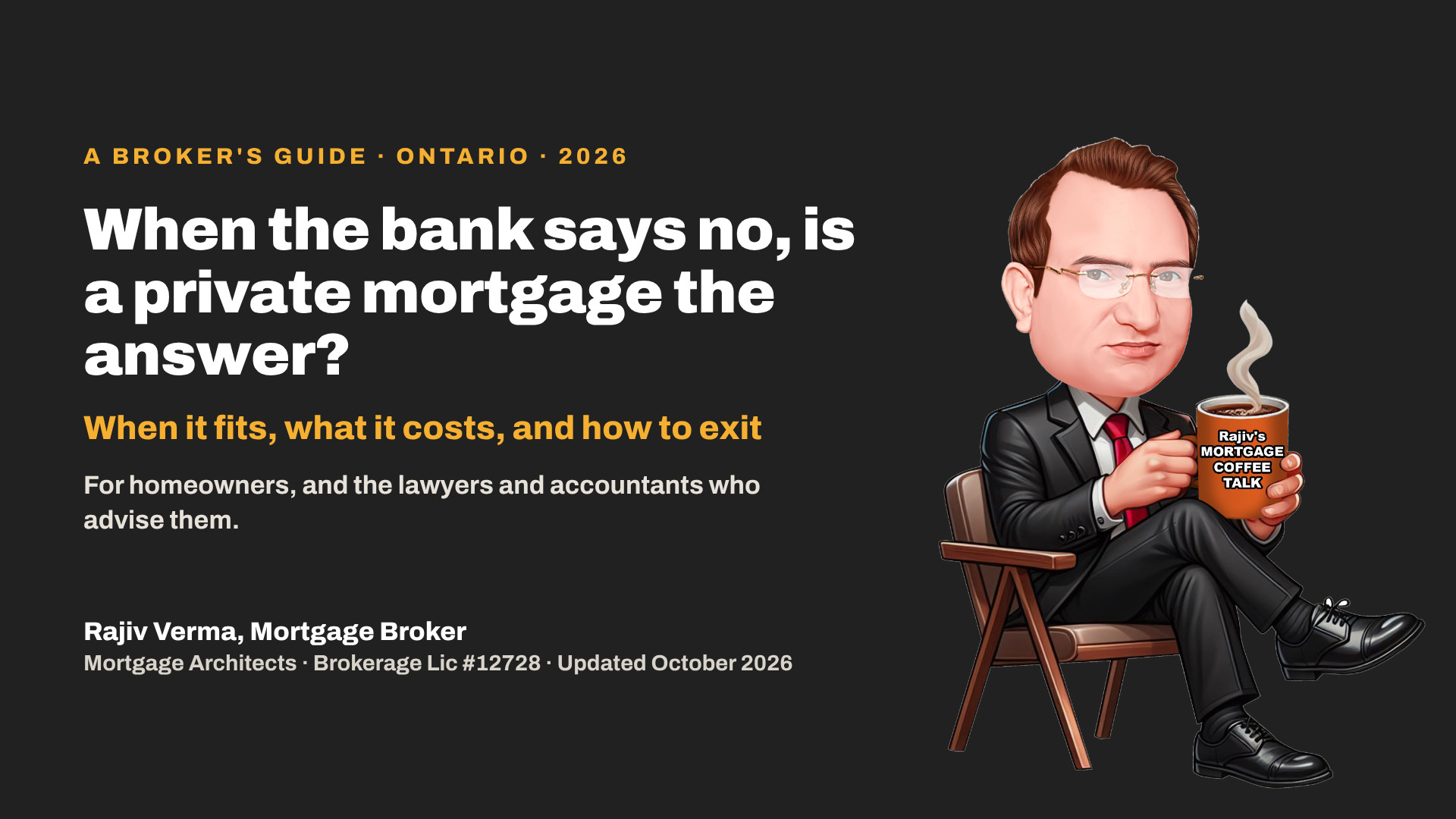
By Rajiv Verma, Mortgage Broker, Mortgage Architects (Brokerage Lic #12728), Brampton, Ontario. Updated October 2026.
A private mortgage is a short-term loan secured against your home by an individual investor or a mortgage investment corporation (MIC), not a bank. It makes sense when three things are true: there is real equity in the property, the reason the bank cannot lend is temporary, and there is a written plan to move to a lower-cost lender or sell within one to two years. Without that exit plan, it is an expensive way to delay a problem.
Private first and second mortgages are a large part of my practice. Most of the people I help with them have built real equity, then hit a short-term problem a bank will not look past: a tax bill, a credit setback, a business slowdown, or a closing that cannot wait.
When does a private mortgage make sense?
When the problem is temporary and the equity is real. The files where it works best involve:
- a purchase that closes before the sale of your current home
- tax owing to the CRA that a bank wants cleared before it will lend
- a credit setback, such as a period of missed payments or a recently discharged consumer proposal
- self-employed income that cannot be shown on paper yet
- a property a bank will not lend on, such as some rural homes or homes that need repair
- arrears on an existing mortgage, when there is still equity to protect
When is a private mortgage the wrong answer?
When nothing will be different at the end of the term. If income will not improve, the debts will keep growing, or the only plan is to renew the private loan again, the costs compound. In those cases, selling on your own timeline, or speaking with a Licensed Insolvency Trustee about a consumer proposal, may protect you better. A good broker should tell you that.
How do private lenders decide?
Private lenders lend mainly against the property, not the paperwork. They look at:
- Equity: most limit all mortgages combined to about 75% to 80% of the home’s value, and less for some areas or unusual properties
- Location and property type: homes that are easy to sell get the best terms
- The exit: how and when the loan will be repaid
- Ability to pay: income still matters, even when it is not documented the way a bank wants
What does a private mortgage really cost?
More than a bank mortgage, in several ways:
- a higher interest rate, usually with interest-only payments
- a lender fee, usually deducted from the advance
- a brokerage fee
- legal fees for your lawyer and often the lender’s lawyer
- an appraisal
- renewal fees if the loan runs past its term
Ontario rules require the brokerage to give you a written disclosure of the full cost of borrowing, including all fees, before you sign. Read it with your lawyer, and compare the total cost with the size of the problem it solves.
Should it be a first or a second mortgage?
A private first mortgage replaces your existing mortgage. A private second sits behind it and leaves your first mortgage in place. A second often costs less overall when your first mortgage has a good rate and a large balance, because only the new money carries the private cost, and you avoid a penalty for breaking the first. A first can make sense when the existing mortgage is small, maturing soon, or in arrears.
What does a good exit plan look like?
Write it down before you sign. The common exits are:
1. Refinance to a mainstream or alternative lender once credit, income or tax filings recover, usually after twelve months of on-time payments.
2. Sell the property on your own timeline, not a lender’s.
3. Close the sale of your current home and repay a bridge loan from the proceeds.
Set a review date three to four months before the term ends, so the next lender has time to approve the file.
An example from practice
This example is a composite of files I see often, with details changed to protect clients.
A Brampton homeowner ran a trucking business that slowed sharply. By the time he called, he owed the CRA about $85,000 in personal tax and HST, and his credit cards were close to their limits. His home had strong equity, and his first mortgage had a good rate with three years left. His bank would not refinance until the CRA balance was cleared and his credit recovered.
Breaking the first mortgage would have meant a large prepayment penalty. Instead, we arranged a one-year private second mortgage. His lawyer paid the CRA and the cards directly from the advance. His accountant set up quarterly instalments so new tax debt would not build. The exit was written down from the first day: twelve months of clean payments, then one refinance with a mainstream or alternative lender to pay out the private second.
What should you prepare?
- Your current mortgage statement and property tax bill
- Photo ID and proof of home insurance
- Any CRA notices or statements of amounts owing
- The income documents you have, even if they are incomplete
- A short explanation of what happened and what has changed since
- Your exit plan, in writing
What should lawyers and accountants know?
Lawyers: private files often close quickly. Expect a commitment with conditions, debts paid out directly from the proceeds, and sometimes guarantors who need independent legal advice. Early contact with the broker avoids closing-day surprises.
Accountants: tell your client early when CRA balances are building. A private mortgage can clear them, but the options are wider and the cost lower when we plan before collection action starts.
Frequently asked questions
Are private mortgages regulated in Ontario?
Yes. Private mortgages arranged through a licensed brokerage fall under Ontario’s mortgage brokering law, overseen by the Financial Services Regulatory Authority of Ontario (FSRA), including written disclosure of the cost of borrowing.
Will a private mortgage help rebuild my credit?
Usually not directly. Many private lenders do not report to the credit bureaus, so keep every other account paid on time while the private mortgage is in place.
Can I pay a private mortgage off early?
It depends on the terms. Some are open after a minimum period; others charge a set number of months’ interest. Check the commitment before you sign.
What if I cannot refinance when the term ends?
You may be able to renew with the private lender for a fee, move to another private lender, or sell. That is why the exit plan matters from the first day.
Plan before you sign
If you, or a client of yours, is considering private money, talk to me before signing anything. I will tell you honestly whether it is the right tool, what it will cost in total, and what the way out looks like. Call me directly at 647.291.7116, or book a strategy session and I will review your file.
Related guides
- Power of Sale in Ontario: how a private mortgage can stop it
- How a second mortgage can save money when your first has a low rate
- Debt consolidation mortgages
This article is general information, not tax, legal or financial advice. Each lender sets its own rules, and every approval depends on the full file.
Rajiv Verma, Mortgage Broker · Mortgage Architects, Brokerage Lic #12728 · Brampton, Ontario
Comments
One response
[…] Private Mortgages in Ontario: When They Make Sense, What They Cost and How to Exit (2026) […]